How Inbound SEO Generated 50+ Monthly Sales Conversations for a B2B Data SaaS [Case Study]
Executive Summary
From Inbound Activity to Defensible Sales Conversations
Most B2B content programs generate plenty of traffic, but struggle to reliably influence commercial decisions.
Though traffic grows and rankings improve, when leadership asks how content is contributing to pipeline — or whether it deserves continued investment — the answers often become uncertain and content leaders are forced to rely on “attribution jiujitsu.”
This case study demonstrates the operating model I developed to solve both problems:
Creating SEO and GEO content that consistently influences commercial buying decisions.
Measuring performance in a way leadership can defend under commercial scrutiny.
More specifically, it describes how I redesigned an inbound SEO program for a B2B data management SaaS company operating in a complex technical buying environment (referred to throughout as Company X for confidentiality).
Rather than optimizing for traffic or search volume, I redesigned the content strategy around buyer decisions. Success was then measured by whether the content consistently influenced sales conversations.
In other words, the primary question that governed the strategy was: What content will help the right buyer make the next commercial decision with greater confidence?
That single shift changes nearly every strategic decision that follows — from which opportunities are prioritized to how content is structured, measured, and reported.
In order to generate and influence sales conversations for my B2B tech clients, I prioritize searches that occur while buyers are actively making commercial decisions—not simply searches with high traffic potential. These include operational challenges, solution exploration, product evaluation, vendor comparisons, and other moments where reducing uncertainty can move buyers closer to commitment.
Each article is designed to move buyers closer to a purchase by creating decision-confidence — i.e., helping them confidently make a specific commercial decision by providing the evidence they need, resolving the uncertainties preventing commitment, addressing the risks and failure modes they want to avoid, and closing the remaining decision gaps. As a secondary benefit, this makes sales conversations more productive because buyers arrive better informed, with fewer unresolved questions, and with greater confidence in their evaluation.
Success was measured not by visits or rankings alone, but by whether inbound content consistently contributed to sales conversations and could withstand executive scrutiny.
Over the course of the engagement, this approach produced:
Consistent influence on 50+ monthly sales conversations
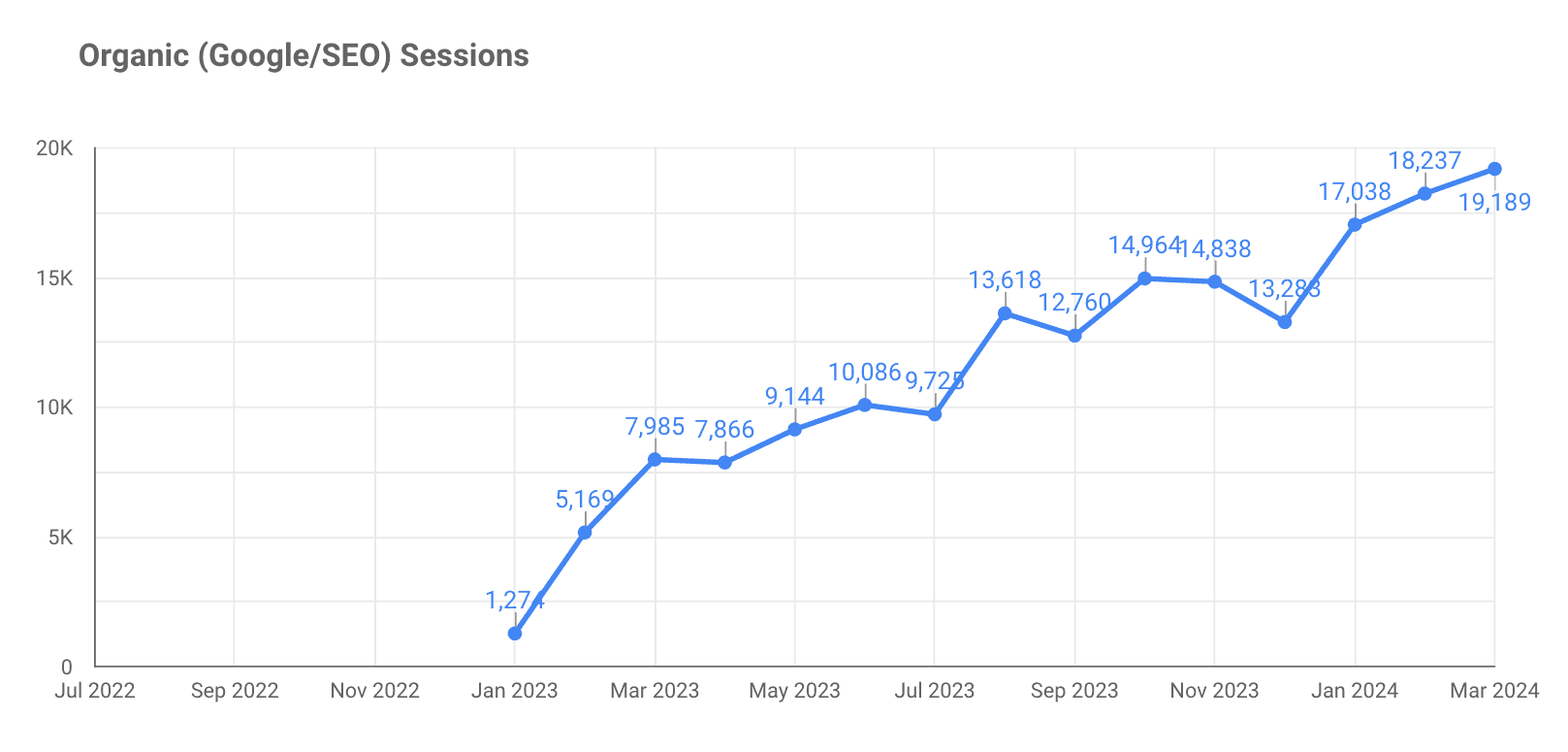
Organic traffic growth from approximately 1,200 to more than 20,000 monthly visits
Greater confidence across marketing and sales that inbound content was contributing meaningfully to commercial outcomes
More importantly, the engagement demonstrated a broader principle.
When content is designed around buyer decisions rather than keyword volume, inbound stops behaving like a marketing experiment that requires continual justification. It becomes a commercial asset that marketing, sales, and leadership can evaluate using the same decision logic they apply to other revenue-generating investments.
This case study documents that strategic approach and explains why it consistently produced commercially meaningful outcomes in a complex B2B buying environment.
NOTE: Throughout this case study, the term “sales conversations” refers to demo or consultation requests that progressed into active sales discussions.
Table of Contents:
Context & Problem
From inbound traffic to sales conversations
The commercial problem: Defensibility
What was broken: Where inbound failed under scrutiny
The decision shift: Reframing inbound around sales conversations
Opportunity Selection Logic
Selecting for buyer motion, not keyword volume
Identifying buyer decisions worth influencing
Validating commercial JTBD keywords
Example: “Reduce s3 replication latency”
Outcome of the selection logic
Content Design Principles
Designing content to advance buyer decisions
Resulting design outcome
Reporting & Outcomes
Measurement & reporting
Results
Key Takeaways & Implications
Why the program became defensible
Where this approach is most effective
Where it’s less effective
What this case actually demonstrates
Appendix: Measurement Artifacts
CONTEXT AND PROBLEMS
From Inbound Traffic to Sales Conversations
This case study describes how I designed and executed a commercial SEO content strategy for Company X, a B2B data management SaaS company selling into technical and operational buyers.
The software solved technically complex data management and synchronization problems — including distributed collaboration, hybrid cloud storage, and disaster recovery — where buying decisions depended on understanding technical tradeoffs, use cases, and capabilities rather than comparing simple feature lists.
The primary target audience included both highly-technical practitioners (such as IT Administrators) and less technical operational stakeholders (such as IT Project Coordinators) — each entering the buying process with different questions, constraints, and information needs.
Buying decisions typically involved multiple stakeholders, long evaluation cycles, and detailed technical scrutiny — making content an important tool for educating buyers, reducing uncertainty, and building consensus before they engaged sales.
Inbound content was expected to play a commercial role (not just generate awareness), including:
Support buyer evaluation
Reduce buying uncertainty
Help buyers self-educate before engaging sales
Generate more productive sales conversations
Generate qualified demo requests
It’s important to understand that these characteristics fundamentally shaped the content strategy. Rather than creating general educational content or targeting high-traffic keywords, the objective was to identify the commercial searches their ICPs made throughout the buying journey and create content that resolved the technical and commercial uncertainties preventing buyers from confidently advancing to the next stage of evaluation. That required selecting topics, structuring content, and measuring success according to buyer decision-making rather than traffic generation.
The core challenge wasn’t just creating an inbound content program. It was designing one that could consistently influence buying decisions in a way that marketing, sales, and leadership could all understand, measure, and defend.
The Commercial Problem: Traffic Wasn’t the Issue. Defensibility Was.
Like many B2B SaaS teams, Company X was investing in content to support inbound growth. But their content output was inconsistent.
Though search visibility was improving and individual articles occasionally generated demo requests, inbound performance wasn’t reliably repeatable. The team couldn’t consistently produce content that influenced pipeline at scale.
Internally, inbound performance was difficult to defend.
Sales questioned the quality of inbound leads.
Leadership wanted credible evidence that content was influencing pipeline.
Attribution models produced inconsistent or inconclusive answers.
As a result, inbound became something marketing had to continually justify rather than a commercial asset whose value was self-evident.
From my perspective, the issue wasn’t a lack of content or even a lack of SEO performance. Their content program wasn’t failing. It was producing exactly the outcomes it had been designed to produce.
During my discovery conversations, it became clear that article topics were typically selected based on three considerations:
Keyword traffic potential
Topics the team believed they “should” cover because they were related to the product
Topics individual engineers were passionate about
Each of these inputs had value. The problem was that none of them systematically accounted for how buyers actually searched, evaluated solutions, or progressed toward a purchasing decision.
Those decisions produced more informational visibility than commercial influence. Traffic accumulated faster than evidence that the content was advancing buying decisions. And as a result, the program’s commercial contribution couldn’t be consistently explained, measured, or defended using the language of commercial performance.
What Was Broken: Where Inbound Failed Under Scrutiny
The team’s underlying issue wasn’t content quality — it was commercial alignment.
Specifically:
Opportunity Selection: Topics were primarily selected based on search demand rather than their ability to influence buyer decisions.
Success Criteria: Inbound success was defined primarily through traffic and rankings rather than buyer progression or commercial outcomes.
Content Design: Articles weren’t consistently designed around specific buyer roles, decision moments, or evaluation-stage uncertainty.
Commercial Alignment: There was no intentional mechanism connecting content consumption to demo requests or sales conversations.
None of these choices were unreasonable in isolation. But together, they made inbound difficult to defend when commercial questions surfaced.
Taken together, these decisions reflected a common assumption: that increasing traffic would naturally increase demos, customers, and pipeline.
That assumption shaped every downstream decision — from which opportunities were pursued to how success was measured. As a result, the content program became highly effective at generating visibility, but far less effective at consistently advancing buyer decisions.
In short, inbound performance existed — but the content program hadn’t been intentionally designed around commercially meaningful outcomes. It had been designed around search visibility, and the results reflected that design.
The implication was clear: improving content quality alone wouldn’t solve the problem. The underlying operating model — the way opportunities were selected, content was designed, and success was measured — needed to change.
The Decision Shift: Reframing Inbound Around Sales Conversations
The turning point wasn’t a new tactic. It was a fundamental realignment of how the content program prioritized opportunities, designed content, and measured success.
Instead of optimizing primarily for traffic growth, the strategy was redesigned around buyer decision-making. And success was measured by whether the content consistently influenced sales conversations.
Sales conversations became the primary measure of success because they were:
Immediately recognizable to Sales
Meaningful to leadership
Defensible under revenue scrutiny without attribution gymnastics
Unlike attribution models or revenue dashboards, sales conversations could be discussed confidently across marketing, sales, and leadership without requiring everyone to accept the same attribution assumptions.
Redefining success around buyer decisions and sales conversations changed what qualified as a worthwhile content opportunity.
High-volume keywords were deprioritized when they were unlikely to influence a meaningful buying decision. Instead, opportunities were prioritized according to where they occurred in the buyer’s decision process and whether resolving that search could realistically move someone closer to requesting a demo.
Content design changed as well. Rather than covering topics broadly, each article was designed to help buyers make a specific commercial decision by reducing uncertainty, providing the evidence they needed, and addressing the risks and tradeoffs that could prevent commitment.
Traffic and rankings remained important diagnostic metrics — but only insofar as they reflected visibility among buyers actively making commercial decisions. In other words, visibility became valuable because it showed content was reaching buyers making important decisions — not simply because it produced more sessions.
Over time, this shift produced two outcomes:
Inbound content consistently influenced 50+ sales conversations per month
Organic traffic compounded significantly — growing from roughly 1,200 monthly visits to over 20,000 per month (≈1,500% increase) across the engagement
More importantly, inbound stopped behaving like a marketing initiative that required continual justification. It became a commercial capability that marketing, sales, and leadership could discuss and evaluate using the same language they used to assess other revenue-generating investments.
OPPORTUNITY SELECTION LOGIC
Selecting for Buyer Motion, Not Keyword Volume
Once inbound success was reframed around sales conversations, the primary selection question changed from “Can we rank for this?” to “Does this search represent a meaningful commercial decision that our ideal buyer is actively trying to make?”
Opportunity selection focused on identifying searches that signaled meaningful buyer motion — queries that occurred during important buyer decision moments (e.g., resolving an operational challenge related to your product, actively evaluating solutions, comparing alternatives, etc.).
Each opportunity was evaluated according to one overarching question: Could resolving this search realistically move an ideal buyer closer to a commercial decision?
That assessment considered:
The specificity of the underlying problem
How close the search occurred to an active buying decision
Whether the searcher matched an important buyer role
The buyer’s Intent Frame—the outcome they were pursuing, the constraints they faced, and the uncertainties they needed to resolve
Search volume was treated as contextual information rather than a decision criterion.
If resolving a query could realistically help an ideal buyer make a meaningful commercial decision — even at very low search volume — it was considered a worthwhile opportunity.
In practice, many of the highest-performing keywords averaged fewer than 100 monthly searches. One of the earliest targets had approximately 20 monthly searches, yet remained among the strongest contributors to sales conversations over the course of the engagement. This reinforced an important lesson: search volume estimates attention, not commercial value.
Why this worked
Traditional keyword research is designed to estimate search demand. While search demand is useful, it says very little about the commercial importance of the decision that caused someone to search in the first place.
The opportunity selection model I use estimates a search’s potential commercial value by evaluating the buyer decision behind it. Because the objective was commercial impact rather than traffic alone, opportunities were prioritized according to their ability to advance meaningful buying decisions — not simply their search volume.
The built-in assumption of my approach is: the value of a search isn’t determined by how many people perform it — it’s determined by the importance of the decision that caused the search.
In practice, this means I’m not primarily selecting keywords to target. I’m selecting buyer decisions that are worth influencing, then identifying the searches that naturally emerge from those decisions.
Identifying Buyer Decisions Worth Influencing
This section illustrates the decision logic used to identify commercial opportunities. It’s intended to explain the reasoning behind the strategy, not provide a universal checklist.
Although commercial searches take many forms, these are the five recurring patterns I’ve observed in how B2B buyers search while making commercial decisions:
Commercial Job-To-Be-Done (JTBD) Queries: Queries made while attempting to complete a commercially relevant job that the product helps accomplish or improve. For example, Company X’s software helps reduce replication latency for data stored in the cloud. So we targeted the keyword “reduce S3 replication latency.”
Category Queries: Queries indicating that the buyer is actively searching for products within the company's category (e.g., "data replication software"). These searches typically occur after the buyer has recognized the need for a solution and is beginning to identify the available options.
Competitor/Alternative Queries: Queries indicating that the buyer is evaluating alternatives to a product they currently use or are already considering (e.g., "GoodSync alternatives"). These searches often signal dissatisfaction with an existing solution or active vendor comparison, making them highly relevant to purchasing decisions.
Comparison Queries: Queries where buyers directly compare two or more products, approaches, or categories in order to make a purchasing decision (e.g., "[Tool A] vs [Tool B]" or "file replication vs file synchronization"). These searches typically occur when buyers are narrowing down their short-list, as they weigh tradeoffs and determine which option best fits their requirements.
Evaluation Queries: Queries where buyers evaluate whether a specific product or approach satisfies their technical, operational, or commercial requirements (e.g., "Is [Tool A] secure?" or "[Tool B] pricing"). Rather than searching for available options, buyers are validating whether a particular solution can adequately meet their needs.
Implementation Queries: Queries made in the final stages of the buyer’s purchasing journey, as they determine whether the solution can be successfully deployed, integrated, governed, or operated within their environment (e.g., "[Tool A] Active Directory integration" or "is [Tool B] Linux-compatible”). Although these searches often occur later in the buying process, they frequently influence purchasing decisions by reducing implementation risk and increasing confidence that adoption will succeed.
Although these categories represent different types of searches, they share one characteristic: each comes from a meaningful commercial decision. Throughout the engagement, opportunities were prioritized according to the commercial importance of that underlying decision rather than search volume alone.
While most of the query categories were relatively easy to assess, JTBD queries required additional scrutiny. These searches occur when buyers encounter operational challenges that your solution helps resolve. Although they often appear informational on the surface, they frequently emerge while buyers are evaluating approaches, reducing operational risk, or determining whether they need a new solution.
However, many JTBD queries are product-relevant but commercially inert. Not every operational challenge creates demand for a new solution. The goal was to identify the ones that did.
Rather than just guessing, I developed a simple decision framework to determine whether a JTBD query was likely to advance buyer decisions and ultimately contribute to sales conversations.
Validating Commercial JTBD Keywords
I evaluated JTBD opportunities using three questions designed to distinguish broadly relevant operational searches from searches that have meaningful commercial potential. The framework below illustrates that decision logic rather than serving as a prescriptive checklist.
1. Is the operational problem something the product helps resolve?
The first question was simple: Does the problem behind the search fall within the product’s actual problem-solving domain?
A JTBD query only became strategically relevant if Company X’s product could materially help the buyer resolve, reduce, or avoid the operational problem driving the search.
This prevented the strategy from pursuing adjacent topics that were technically related to the product category but had no meaningful connection to the value the product delivered.
Put simply: If the product doesn’t help solve the problem, the search isn’t a commercial opportunity for the product.
2. Does the job carry meaningful risk?
The second signal was the cost of getting the job wrong.
Operational problems carrying meaningful financial, technical, regulatory, or professional consequences created stronger reasons for buyers to investigate their options carefully.
As the consequences of failure increased, the information buyers needed often extended beyond simply asking, “How do I do this?” Buyers also needed to understand which approach was safest, most reliable, or least likely to create downstream problems.
That created opportunities for content to influence how buyers evaluated potential solutions.
The more expensive the mistake, the more commercially important the answer became.
3. How much uncertainty exists behind the job?
The third signal was uncertainty.
Some operational problems have straightforward answers. Others depend heavily on the buyer’s environment, constraints, requirements, or tolerance for risk.
The latter created greater opportunity for content to influence evaluation because buyers needed more information before they could confidently choose an approach.
Two forms of uncertainty were especially useful signals during this engagement:
Compliance uncertainty: The buyer needed to determine whether an approach would satisfy security, regulatory, or governance requirements.
Variability uncertainty: The correct approach depended heavily on context — for example, infrastructure, workload, company size, technical requirements, or operating environment.
When the answer is “it depends,” buyers have more to evaluate.
How the three signals worked together
None of these factors determined commercial potential on its own.
Product relevance established whether the problem belonged within Company X’s commercial territory. Risk and uncertainty helped determine how important resolving that problem was to the buyer — and therefore how much opportunity existed for content to influence evaluation.
In practical terms: Product relevance got a query considered. Risk and uncertainty helped determine whether it deserved investment.
Example: “Reduce S3 Replication Latency”
Consider the JTBD query “reduce S3 replication latency.”
On the surface, it looks like a technical troubleshooting search rather than a commercial query. That’s precisely why surface-level intent and search volume weren’t enough to evaluate it.
Product relevance
Replication performance was directly related to a problem Company X’s software helped resolve. Improving data transfer and synchronization performance sat squarely within the product’s value proposition.
Risk
In environments where replication speed affected data availability, workflow performance, recovery objectives, or system reliability, poor replication performance could create meaningful operational consequences.
Uncertainty
The correct solution wasn’t universal.
It depended on factors such as dataset size, system architecture, network conditions, performance requirements, regulatory constraints, and failure tolerance.
That combination made the query commercially interesting despite its low search volume.
The article targeting the query went on to influence sales conversations throughout the engagement.
Applying this logic across JTBD opportunities allowed me to concentrate content investment on operational problems where three things were true:
Company X could genuinely help resolve the problem
Getting the problem wrong carried meaningful consequences
Buyers faced enough uncertainty that guidance could materially influence how they evaluated solutions
Not every product-related problem creates commercial demand. The goal was to identify the ones where solving the problem mattered enough — and was uncertain enough — to influence what buyers did next.
Outcome of the Selection Logic
Applying this logic intentionally narrowed the content roadmap.
Rather than treating product relevance or search demand as sufficient reasons to create content, opportunities had to demonstrate a plausible connection to a meaningful buyer decision. This filtered out topics that could generate traffic but offered little reason to believe they would influence evaluation or sales conversations.
As a result, content investment became concentrated on a smaller set of commercially meaningful searches: problems buyers needed to solve, decisions they needed to make, and uncertainties they needed to resolve as they moved toward a purchase.
The goal wasn’t to find more keywords. It was to identify the buyer decisions most worth influencing.
This selection discipline made the strategy easier to execute and the resulting performance easier to explain. When content generated traffic, rankings, or conversions, there was a clear commercial rationale for why that opportunity had been pursued in the first place.
A smaller roadmap of commercially justified opportunities was more valuable than a larger roadmap built around search demand.
CONTENT DESIGN PRINCIPLES
Designing Content to Advance Buyer Decisions
Once an opportunity was selected, the next question was: If the right buyer found this article while making a purchasing decision, would it actually help them move forward?
Ranking for a commercially valuable query created the opportunity to influence a decision. The article still had to do the work.
That meant designing content around the decision behind the search: what the buyer was trying to accomplish, what they needed to understand, what risks or failure modes they were concerned about, and what evidence they needed to proceed confidently.
The goal wasn’t simply to answer the search. It was to help the buyer make the decision that caused the search.
That required a different content design approach from conventional SEO articles.
Principle 1: Start with the buyer's decision moment
Each article was designed around a specific buyer decision rather than a broad topic.
Instead of beginning with: “What information should this article include?”
I began with: “What is this buyer trying to decide or accomplish right now?”
That decision could involve describing an approach, evaluating a solution, comparing alternatives, validating technical requirements, reducing implementation risk, or determining whether an existing solution was still sufficient.
Identifying the Decision Moment established the job the content needed to perform.
The keyword told me what the buyer searched. The Decision Moment told me why the answer mattered.
Principle 2: Design around the buyer's Intent Frames
Knowing the decision wasn’t enough. I also needed to understand the conditions under which the buyer was making it.
For each article, I developed an Intent Frame around five questions:
Real Objective: What decision or task is driving this search, and what outcome is the buyer trying to achieve?
Negative Intent: What risks, negative outcomes, or failure modes are they trying to avoid?
Constraints: What constraints affect which solution will work for this buyer (e.g., budget, tech stack, team size, etc.)?
Decision Gaps: What missing information does the buyer need before they can proceed confidently?
Answer Contract: What answer format will best help the buyer make their decision and achieve their ideal outcome.
(NOTE: This is the same framework that AI tools use to interpret and answer user queries — which significantly helps my content get cited in AI answers.)
Designing articles around Intent Frames ensured that they did more than just provide information — they provided decision-support.
For example, two buyers might search the same keyword while operating under very different technical constraints, risk tolerances, or requirements. Content needed to address the conditions that actually shaped their decision.
Answering the query wasn’t enough. The answer had to work within the buyer’s reality.
Intent Frames were also used to accomplish two important objectives in each article:
Create resonance by describing and addressing the buyer’s lived experience. This makes the buyer feel like the article was written by someone who’s been in and/or resolved their exact situation before — which builds trust and confidence.
Every article mentioned Company X’s product in some way. Intent Frames enabled me to tailor product mentions to the buyer’s specific needs and context.
Content that aligned with these frames consistently surfaced in sales conversations.
Principle 3: Close the Decision Gaps preventing progress
The Intent Frame helped me identify the specific uncertainties preventing the buyer from confidently moving forward.
These Decision Gaps could include questions about:
Technical feasibility
Product capabilities
Tradeoffs and limitations
Security or compliance
Implementation requirements
Compatibility with existing infrastructure
Cost or resource requirements
Evidence that the proposed approach would actually work
Article structure was then built around resolving the Decision Gaps most likely to stall the decision.
This meant the goal wasn’t exhaustive topical coverage. It was providing the information and evidence the buyer actually needed to proceed.
Good content doesn’t answer every possible question. It answers the questions standing between the buyer and a decision.
Principle 4: Organize content around risks, evidence, and tradeoffs
Buyers evaluating complex B2B technology rarely need another list of product features. They need to understand what those capabilities mean for the decision they’re making.
Article sections were therefore organized around considerations such as:
Risks and failure modes
Tradeoffs and limitations
Technical constraints
Desired outcomes and success criteria
Evidence supporting important claims
How specific product capabilities addressed the buyer’s requirements
Product features were introduced in the context of the buyer problem they helped resolve — not as isolated selling points.
The product wasn’t the organizing principle. The buyer’s decision was.
Principle 5: Design toward Decision-Confidence
Every article needed an endpoint: what should the buyer understand or believe by the time the content had done its job?
I used this as an informal Exit Criterion for the page.
The objective wasn’t to force a conversion before the buyer was ready. It was to give them enough information and evidence to confidently take the next logical step — whether that meant narrowing their options, changing their approach, evaluating Company X, or requesting a demo.
This also improved the quality of downstream sales conversations because buyers could arrive better informed about their problem, available approaches, and Company X’s fit.
The objective wasn’t to manufacture urgency. It was to remove the uncertainty preventing progress.
An additional design requirement: Sales legibility
Content also needed to be recognizable and useful to Sales.
That meant using terminology buyers actually used, avoiding abstract positioning language, and structuring important explanations so they could be easily referenced or shared during evaluation.
This created continuity between the buyer’s self-directed research and later conversations with Sales.
The article and the sales conversation shouldn’t feel like two different explanations of the product.
Resulting Design Outcome
The resulting content did not resemble conventional SEO articles.
Pages were more deliberate and less noisy — but significantly more useful in evaluation contexts.
Traditional on-page SEO practices were still applied, but they were subordinate to the article’s commercial job. When an optimization conflicted with clarity, credibility, or the information buyers needed to make the decision, decision support took priority.
SEO earned the visit. The content still had to earn the buyer’s confidence.
Over time, these design disciplines contributed to:
Increased alignment between sales and inbound content
More consistent use of content in deals
More sales conversations generated from, and influenced by, content
Improved confidence in inbound as a defensible commercial asset
REPORTING & OUTCOMES
Measurement and Reporting
Before reviewing the results, it’s important to clarify how success was measured.
The reporting model was designed to answer a practical commercial question: Is inbound content consistently contributing to sales conversations?
Company X had a complex, multi-touch buying cycle, so I didn’t attempt to assign revenue to individual articles when the available evidence couldn’t support that level of attribution. Instead, I used the strongest signals available to distinguish directly attributable outcomes from evidence of content influence.
The goal wasn’t to claim more attribution than the data could prove. It was to make the commercial contribution of inbound as legible as the evidence allowed.
Primary KPI: Sales conversations
The primary measure of success was sales conversations: demo or consultation requests generated through inbound content that progressed into active sales discussions.
This provided the clearest commercial signal because it captured an observable transition from content consumption into the sales process.
Rather than asking whether content merely attracted visitors, reporting could answer a more meaningful question: Did buyers consuming this content raise their hands to talk to Sales?
Supporting signals: Content influence
Not every contribution could be captured through direct conversion attribution.
To understand how content influenced buyers across a longer evaluation cycle, I also monitored supporting signals such as:
First-touch and assisted conversions involving inbound content
Repeated appearance of specific articles within conversion paths
Sales references to inbound content during buyer evaluations
These signals weren’t treated as equivalent to directly generated demo requests. They provided additional evidence that content was participating in commercially meaningful buyer journeys.
Direct conversions showed where content generated sales conversations. Supporting signals showed where it helped buyers get there.
Diagnostic metrics: Traffic, rankings, and engagement
Traffic, rankings, and engagement were still monitored, but they served a different purpose.
They helped diagnose whether content was being discovered, whether target queries were gaining visibility, and where performance might need improvement. They weren’t treated as evidence of commercial success on their own.
Rankings told us whether the acquisition system was working. Sales conversations told us whether the strategy was working.
Reporting without attribution gymnastics
This measurement hierarchy made reporting more defensible because different signals weren’t asked to prove more than they actually could.
Dashboards served as supporting artifacts rather than decision drivers.
Attribution data informed the commercial picture without being treated as perfect causal evidence.
Sales feedback provided additional validation of whether inbound buyers remained relevant after entering the pipeline.
This measurement and reporting framework produced a data-driven narrative that told leadership how content should be evaluated and validated that content was influencing pipeline for the business. In simpler terms, answered two questions:
How is content supposed to influence pipeline?
Is our content influencing pipeline?
The result was a reporting model that allowed marketing, Sales, and leadership to discuss inbound performance in commercial terms without requiring everyone to accept the same attribution assumptions.
The objective wasn’t perfect attribution. It was enough reliable evidence to make better decisions about the channel.
Downstream validation: Lead quality
Sales feedback also provided an important downstream check on lead quality.
During the period reviewed, the Sales team reported that approximately one out of every nine demos progressed to become a customer.
I treated this as supporting evidence that inbound was generating commercially relevant conversations — not as proof that individual articles caused those purchases or as a universal conversion benchmark.
The purpose of the metric was to validate that the conversations generated by inbound had meaningful downstream value without claiming a level of revenue attribution the data couldn’t support.
All of the sales feedback was especially important for strengthening internal buy-in. Including Sales in measurement created shared ownership of the content program’s commercial outcomes.
And rather than asking Sales and leadership to just accept Marketing’s interpretation of content performance, Sales helped validate whether inbound content was generating relevant buyers and improving sales conversations. This gave leadership an additional signal from the team closest to revenue, and made content’s contribution easier to understand and trust.
Content performance was more credible when Marketing wasn’t the only team saying it worked.
Results
The results are presented in the same order the program measured success: commercial outcomes first, visibility metrics second.
The primary question wasn’t whether SEO performance improved. It was whether that performance translated into commercially meaningful buyer behavior.
1. 50+ monthly sales conversations influenced by inbound content
Inbound content consistently generated and influenced 50+ sales conversations per month, including buyers who requested demos directly through article CTAs.
Sales also increasingly referenced specific articles during evaluation conversations, providing additional evidence that content was helping buyers evaluate Company X before and during the sales process.
2. Inbound became commercially defensible
Inbound moved from a channel whose value required continual explanation to one whose commercial contribution could be discussed using outcomes Sales and leadership already recognized.
Sales conversations provided a clear primary KPI, while conversion-path data and Sales feedback supplied supporting evidence of content influence. Marketing no longer needed to rely primarily on traffic growth or aggressive attribution claims to justify the program.
The conversation shifted from “Is content actually contributing?” to “How do we produce more of what’s working?”
3. Organic traffic grew ≈1,600% without becoming the governing KPI
While the strategy prioritized commercial relevance over search volume, organic traffic still compounded from approximately 1,200 monthly visits to more than 20,000 — an increase of roughly 1,600%.
The result demonstrated that commercial prioritization didn’t require sacrificing organic growth. Traffic remained valuable as an acquisition and diagnostic signal; it simply wasn’t treated as proof of commercial success on its own.
KEY TAKEAWAYS: WHY THIS WORKED
The results weren’t produced by a single SEO tactic. They came from aligning the entire content system around commercially meaningful buyer decisions—from opportunity selection and article design through measurement and reporting.
Keywords were selected because the decisions behind them were worth influencing. Articles were designed to reduce the uncertainty preventing those decisions. Success was measured through observable commercial behavior, with Sales providing additional validation of downstream relevance.
The strategy worked because selection, content design, and measurement were all optimizing for the same outcome.
Why the Program Became Defensible
The program also became easier to defend internally because its measurement matched the strength of the available evidence:
Direct demo conversions showed where content generated sales conversations.
Conversion-path data and Sales feedback showed where content plausibly influenced buyer progression.
Traffic and rankings were used as diagnostic indicators rather than proof of commercial impact.
Revenue wasn’t attributed to individual pages when the available evidence couldn’t support that claim.
This allowed inbound performance to be discussed in commercial terms without requiring aggressive attribution assumptions or a single dashboard to “prove” impact.
Marketing could show the evidence. Sales could validate that it mattered. Leadership could understand what the investment was producing.
Where This Approach is Most Effective
This approach is best suited to buying environments where content can meaningfully influence how customers evaluate a purchase. That generally means:
Buying cycles involve meaningful research or evaluation.
Buyers face enough risk or uncertainty to seek information before purchasing.
Multiple solutions or approaches must be evaluated.
Buyers conduct meaningful online research before or during the sales process.
Content has an opportunity to influence evaluation before a final purchasing decision.
The more research and uncertainty that exists between problem recognition and purchase, the more opportunity content has to influence the decision.
Where It’s Less Effective
The model becomes less useful when:
Purchases require little research or evaluation.
Products are largely commoditized and buyers perceive few meaningful differences between alternatives.
The objective is primarily reach, awareness, or impressions rather than commercial buyer behavior.
Buyers don’t meaningfully research their problems or potential solutions through search.
I encountered it directly during a separate engagement with a cloud broadcasting software company. Despite applying a similar commercial content methodology, the program generated no attributable lead conversions during the engagement. The experience reinforced an important boundary condition: content can’t influence a buying journey that buyers aren’t actually conducting through search.
Buyer research behavior has to exist before SEO can capture it.
What This Case Actually Demonstrates
This case doesn’t demonstrate that SEO is fast, that every commercial search will generate pipeline, or that content deserves sole credit for revenue in a complex B2B buying cycle.
Nor does it suggest that traffic and rankings don’t matter. They do — but they measure different parts of the system.
What the engagement demonstrates is that inbound content can become a measurable commercial capability when three parts of the program are aligned:
Opportunity Selection: Target searches connected to buyer decisions worth influencing.
Content Design: Give buyers the information and evidence they need to resolve uncertainty and move forward confidently.
Measurement: Evaluate success using the strongest commercially meaningful evidence available without claiming more attribution than the data supports.
Choose buyer decisions worth influencing. Build content that helps buyers make them. Measure whether their behavior changes.
The larger lesson is that commercial content doesn’t begin with keywords. It begins with buyer decisions.
When opportunity selection starts with the decisions buyers are trying to make, content can be designed around the uncertainty preventing those decisions. When measurement then captures the resulting commercial behavior, content’s contribution becomes easier to understand, improve, and defend.
That’s the shift: from creating content that attracts traffic to building a content system designed to advance buyer decisions—and producing evidence that it does.
APPENDIX: MEASUREMENT ARTIFACTS
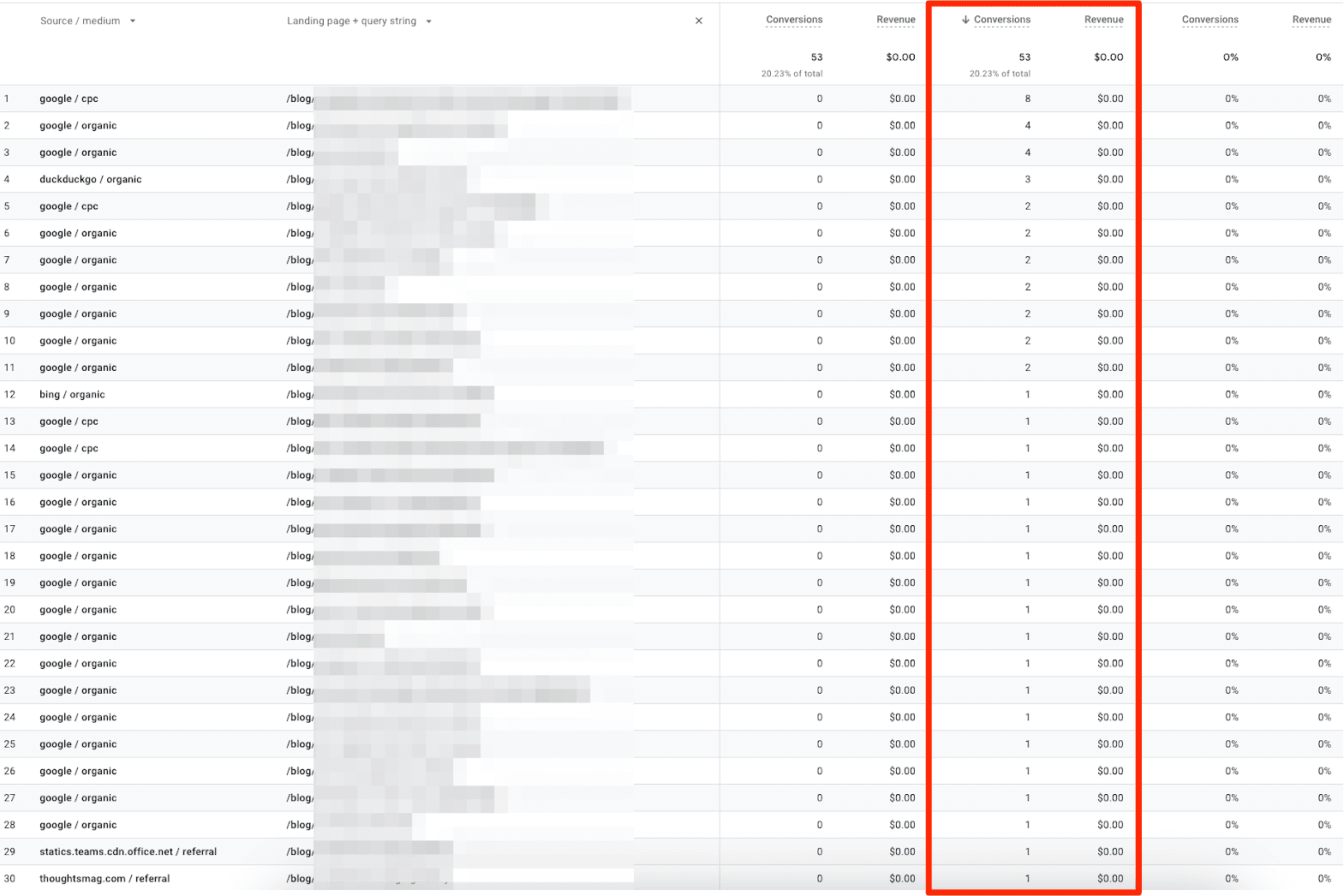
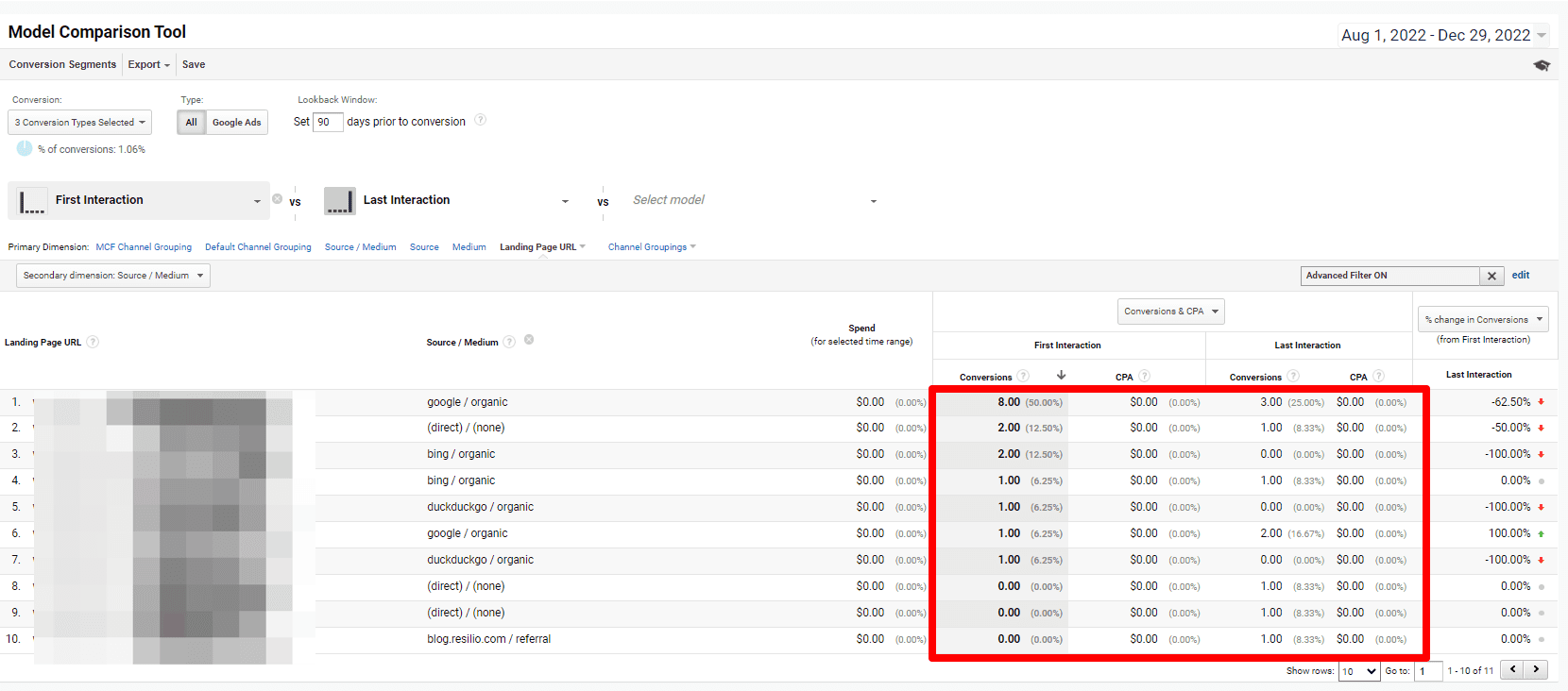
The following screenshots are included as illustrative artifacts, not as claims of direct revenue attribution.
They are provided to show how inbound content surfaced within conversion paths and sales-relevant interactions over time — particularly as first-touch or assisted interactions.
Given the complexity of the buying cycle, these artifacts were never used as standalone proof of performance.
They supported internal discussion alongside sales feedback and pipeline observation.
URLs and identifying details have been intentionally obscured to protect client information.
Inbound Content Appearing in Conversion Paths
Illustrative view of inbound content contributing to first-touch and assisted conversions over a 30-day lookback window (November 2023).
Early Inbound Traction on Conversion Paths
Illustrative view of inbound content contributing to first-touch and assisted conversions across first 5-months of engagement (August 2022 - December 2022).
Traffic Growth During the Engagement
Illustrative view of traffic growth across a 22-month period (engagement lasted July 2022 — May 2024).